Artificial intelligence is rapidly transforming the robotics industry, bringing automation to sectors previously dependent on human labor. From manufacturing floors to hospital operating rooms, AI-powered robots are taking on tasks that require precision, consistency, and adaptability that humans struggle to maintain over long shifts.
The global AI robotics market reached $23.9 billion in 2025 and is projected to surpass $85 billion by 2032, according to Grand View Research. This explosive growth reflects both declining hardware costs and breakthroughs in machine learning that allow robots to learn from experience rather than requiring explicit programming for every scenario.
Unlike traditional industrial robots that repeat fixed motions, AI-enabled systems can perceive their environment, make decisions, and adjust their actions in real time. This capability opens entirely new applications across logistics, healthcare, agriculture, and construction.
Transforming Manufacturing and Logistics
The most immediate impact of AI robotics is in manufacturing, where smart robots now handle quality inspection, assembly of complex components, and warehouse order fulfillment. Companies like Boston Dynamics and Agility Robotics are deploying humanoid-style robots that can navigate unstructured environments alongside human workers.
Amazon operates over 750,000 robots in its fulfillment centers, reducing order processing times by 40% compared to facilities without robotic assistance. These robots use computer vision and reinforcement learning to pick, sort, and transport items with increasing speed and accuracy each quarter.
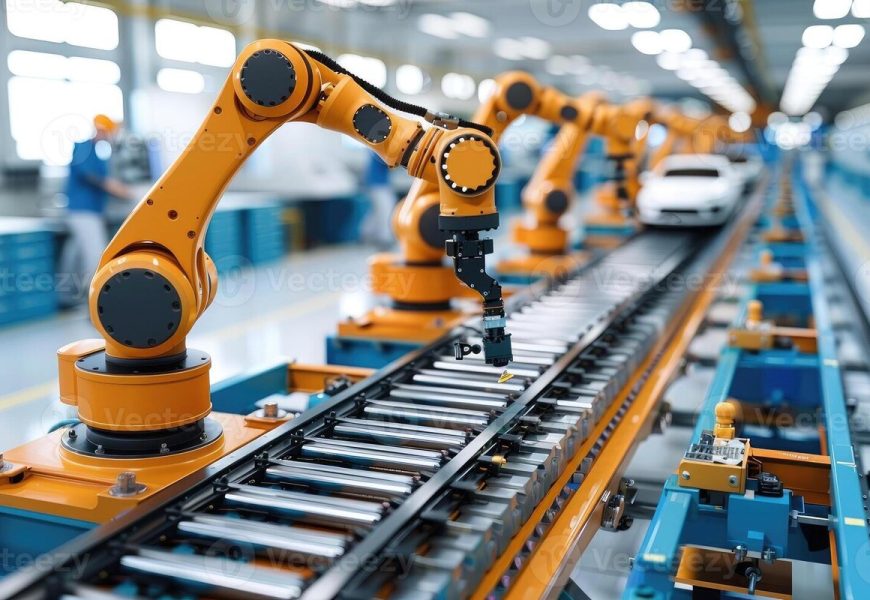
Automotive manufacturers have also adopted collaborative robots, known as cobots, that work directly alongside humans on assembly lines. Unlike traditional industrial arms locked behind safety cages, cobots detect human proximity and adjust their force and speed accordingly, reducing injury risks while boosting productivity.
Healthcare and Surgery
In healthcare, AI-powered surgical robots are achieving outcomes that rival or exceed those of experienced surgeons. The da Vinci surgical system, now enhanced with AI-guided instrument tracking, has performed over 12 million procedures worldwide.
Newer systems from companies like CMR Surgical offer portable surgical robots that can be deployed in remote or resource-limited settings.
AI robots are also assisting in rehabilitation, patient monitoring, and medication dispensing. In elder care facilities across Japan and Europe, companion robots monitor vital signs, remind patients to take medications, and provide social interaction that reduces feelings of isolation among residents.
Agriculture and Environmental Applications
Autonomous robots equipped with computer vision are transforming agriculture by precisely applying herbicides only where weeds are detected, reducing chemical usage by up to 80%. Solar-powered weeding robots from companies like Carbon Robotics use lasers to kill weeds without disturbing soil structure or introducing chemicals into the food supply.
In environmental monitoring, underwater drones navigate coral reefs and river systems to collect data on water quality, species populations, and pollution levels. These robots operate for weeks at a time, generating data sets that would take human researchers years to compile manually.
Challenges and Ethical Considerations
The rapid deployment of AI robotics raises significant concerns about workforce displacement. The World Economic Forum estimates that automation could displace 85 million jobs by 2030, while creating 97 million new roles — a net positive figure that nonetheless requires massive retraining programs to realize.
Workers in manufacturing, logistics, and routine office tasks face the highest displacement risk. Policymakers and industry leaders must invest in education and transition programs to ensure the benefits of automation are broadly shared rather than concentrated among technology owners.
Safety and accountability present additional challenges. When an AI robot makes an error — whether in surgery, construction, or autonomous driving — determining liability between the manufacturer, the software developer, and the operator remains an unresolved legal question across most jurisdictions.
Privacy concerns also arise as robots equipped with cameras and sensors collect vast amounts of environmental data. Regulations like the EU’s AI Act attempt to establish guardrails, but enforcement lags behind deployment speed.
The technology is outpacing the frameworks designed to govern it, creating a growing accountability gap that industry and regulators must address collaboratively.
For businesses and workers alike, the message is straightforward: AI-powered robotics is not a future possibility but a present reality. Those who adapt early — by learning to work alongside intelligent machines or by implementing automation thoughtfully — will navigate the transition most successfully.