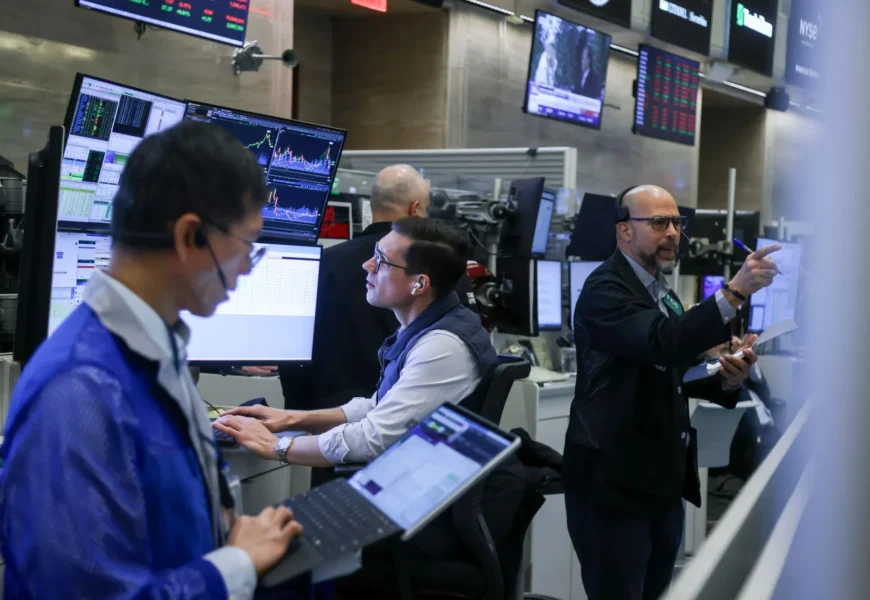
The Nasdaq Composite registered its strongest monthly performance in six years during April 2026, fuelled by unprecedented demand for artificial intelligence infrastructure and a broad-based rally in technology stocks that has defied broader economic headwinds. The milestone marks a significant inflection point for markets as investors increasingly price in the transformative potential of AI across every sector of the global economy.
The index gained more than 12% in April, its best monthly showing since early 2020, when pandemic-driven technology spending initially sparked a similar surge. This time, however, the catalyst is more structural: corporations across industries are committing billions to AI deployment, and the infrastructure required to support these ambitions—data centres, specialised chips, cloud platforms—has become the focal point of a new technology investment cycle.
**The AI Infrastructure Boom**
Driving the rally is a straightforward thesis: if AI is going to transform every business, someone has to build the underlying infrastructure. Chip manufacturers like Nvidia and AMD have emerged as the primary beneficiaries, with their products commanding premium prices and multi-year order backlogs. Lisa Su, AMD’s CEO, recently reinforced this narrative, stating that AI agents are driving “tremendous demand” across the technology sector.
The Magnificent Seven—Alphabet, Amazon, Apple, Meta, Microsoft, Nvidia, and Tesla—have collectively outperformed, with Alphabet inching closer to Nvidia in market capitalisation as investors bet that its AI integration across Search, Cloud, and YouTube will translate into durable revenue growth. Intel has similarly benefited from renewed interest in domestic chip manufacturing, driven by government incentives and the reshoring of semiconductor production to the United States.
**Record Highs and Easing Oil Prices**
May 2026 has seen the S&P 500 and Nasdaq reach fresh record highs, supported by falling oil prices that have eased inflation concerns. The ceasefire between the United States and Iran remains intact, removing a key source of market uncertainty that had weighed on investor sentiment in previous months.
A drop in crude prices has boosted consumer spending power and reduced input costs for businesses, creating a favourable environment for risk assets. Combined with stronger-than-expected private payroll data—ADP reported 109,000 new jobs added in April—the macroeconomic backdrop has become increasingly supportive of equity valuations.
**Tariff Concerns and Market Resilience**
Despite the celebratory mood, some analysts caution that the rally could face headwinds from escalating trade tensions. President Trump has threatened to increase tariffs on European vehicles to 25%, a move that could disrupt transatlantic supply chains and dampen sentiment in the automotive and industrial technology sectors.
Yet the market has demonstrated remarkable resilience in recent weeks, absorbing negative headlines with relative equanimity. The phenomenon has earned the current environment the moniker “Teflon market”—an acknowledgement that price declines have been shallow and brief, with buyers stepping in at every turn.
**What’s Driving This Particular Rally**
Several factors distinguish the current surge from previous technology rallies. First, AI adoption is occurring across industries simultaneously—finance, healthcare, logistics, retail—rather than being concentrated in technology companies alone. Second, the infrastructure buildout is still in its early stages, with data centre construction pipelines extending well into 2027 and beyond. Third, monetisation is finally becoming visible, with companies reporting measurable revenue contributions from AI-powered products and services.
For investors, the challenge lies in separating companies with genuine AI advantages from those simply riding the trend. The coming months will test whether the current valuations are justified by fundamentals or whether some of the more speculative bets will need to be unwound as reality catches up with expectations.